-

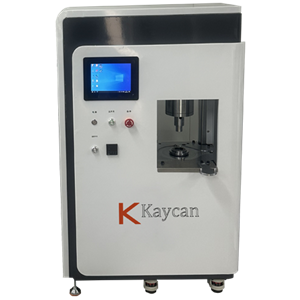
Benchtop Four Ball Wear Tester
KN-2783P Automatic Four Ball Wear Tester is used to test the Wear Preventive (WP) and Extreme Pressure (EP) characteristics of greases and lubricating oils in sliding steel-on-steel applications. It conforms to the ASTM D2783, ASTM D2266, ASTM D2596,ASTM D5183, ASTM D4172, IP 239 and ISO 20623.The tester adopts sliding friction, under the high point contact pressure, to evaluate the carrying capacity of the lubricant. It includes the maximum no seizure load PB, sintering load PD and composite wear value ZMZ three items indexes. The tested is also used for the long-time abrasion resistance tests, to measure the friction coefficient.
Send Email Details -
ASTM D6079 Evaluating Lubricity Of Diesel Fuels By The HFRR
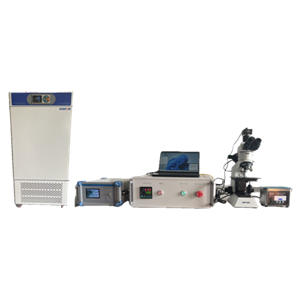
Diesel fuel injection equipment has some reliance on lubricating properties of the diesel fuel. Shortened life of engine components, such as diesel fuel injection pumps and injectors, has sometimes been ascribed to lack of lubricity in a diesel fuel
Send Email Details -
ASTM D5001 Ball-on-Cylinder Lubricity Evaluator (BOCLE)
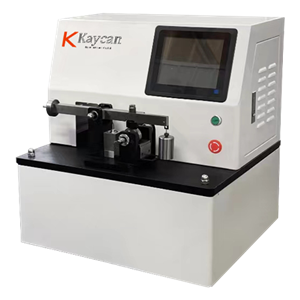
KN-5001 Ball-on-Cylinder Lubricity Evaluator (BOCLE) conforms to ASTM D5001 Standard Test Method for Measurement of Lubricity of Aviation Turbine Fuels by the Ball-on-Cylinder Lubricity Evaluator (BOCLE) and ASTM D6078 Standard Test Method for Evaluating Lubricity of Diesel Fuels by the Scuffing Load Ball-on-Cylinder Lubricity Evaluator (SLBOCLE).. The fluid under test is placed in a test reservoir in which atmospheric air is maintained at 10% relative humidity. A non-rotating steel ball is held in a vertically mounted chuck and forced against the outside diameter of an axially mounted cylindrical steel ring with an applied load. The test ring is rotated at a fixed speed while being partially immersed in the fluid reservoir. This maintains the ring in a wet condition and continuously transports the test fluid to the ball/ring interface. The wear scar generated on the test ball is a measure of the lubricating property of the fluid.
Send Email Details -
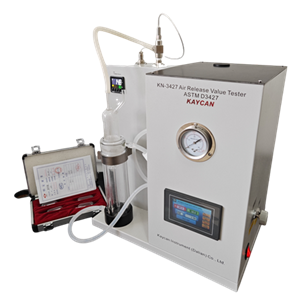
ASTM D3427 Air Release Properties Of Hydrocarbon Based Oils
Agitation of lubricating oil with air in equipment, such as bearings, couplings, gears, pumps, and oil return lines, may produce a dispersion of finely divided air bubbles in the oil. If the residence time in the reservoir is too short to allow the air bubbles to rise to the oil surface, a mixture of air and oil will circulate through the lubricating oil system. This may result in an inability to maintain oil pressure (particularly with centrifugal pumps), incomplete oil films in bearings and gears,and poor hydraulic system performance or failure.
Send Email Details -
Grease Separation Apparatus
KN-392 Grease Separation Apparatus conforms to the GB/T392, The apparatus covers the determination of the tendency of a lubricating grease to separate oil during storage in both normally filled and partially filled containers.
Send Email Details -
IP 121 Apparatus for Oil Separation from Lubricating Grease
KN-121 Apparatus for Oil Separation from Lubricating Grease conforms to IP 121 Determination of Oil Separation from Lubricating Grease – Pressure Filtration Method. A cylindrical column of grease resting on a metal gauze cone is subjected to a fixed pressure in excess of the hydrostatic pressure of the grease. The quantity of oil separated through the gauze after standing for 42h or 168h at 40℃ is taken as a measure of the stability of the grease towards oil separation during storage.
Send Email Details -
ASTM D217 Motorized Grease Worker
Cone penetration test results provide one measure of the consistency of a grease. Worked penetration results are required to determine to which NLGI consistency grade a grease belongs. Undisturbed penetration results provide a means of evaluating the effect of storage conditions on grease consistency
Send Email Details -
ASTM D217 Motorized Grease Worker Single Station
Cone penetration test results provide one measure of the consistency of a grease. Worked penetration results are required to determine to which NLGI consistency grade a grease belongs. Undisturbed penetration results provide a means of evaluating the effect of storage conditions on grease consistency
Send Email Details